A condition grade is an assessment of how far an asset has deteriorated, expressed on a scale that a capital programme can act on. The scale is a convention; what matters is that the same defect gets the same grade twice, and that a grade leads to a decision.
Asset condition grade: the number that releases the money
period FY2026 · Q3 — closes 2026-09-30folio 106recast the figures above move with the periodkept by The Scupper Ledger (a named ledger, not a person)
What the grade is based on
A closed-circuit television survey of a pipe records defects: cracks, deformation, joint displacement, root intrusion, debris, infiltration. Each defect has a severity and a position, and the scoring system converts them into a single grade for the length surveyed. The grade is therefore a summary of a long record, and the record is the evidence.
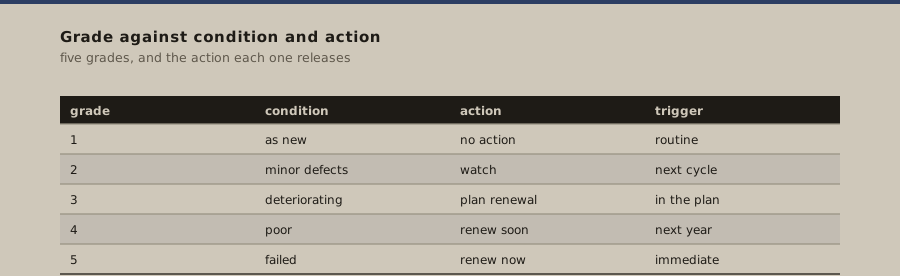
| Grade | Condition | Action | Typical trigger |
|---|---|---|---|
| 1 | as new | no action | routine |
| 2 | minor defects | watch | next cycle |
| 3 | deteriorating | plan renewal | within the plan |
| 4 | poor | renew soon | next programme year |
| 5 | failed or failing | renew now | immediate |
Why the grade is not the decision
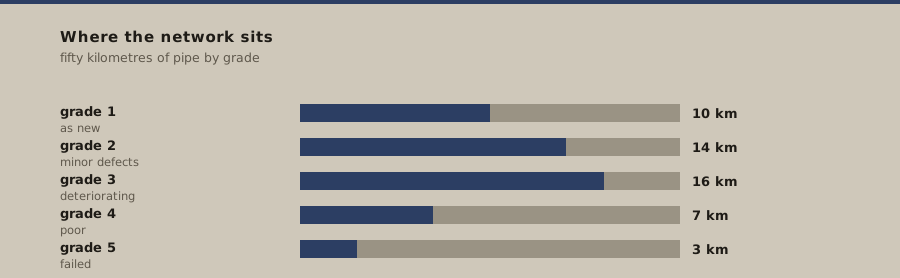
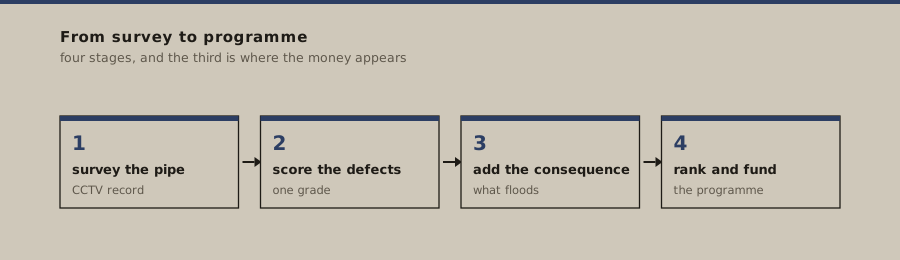
A grade says what the asset is. It does not say whether renewing it is worth the money, and it does not say which of two grade-4 pipes should be done first. That requires a consequence: what floods, how many properties, how deep, how often. A network with two grade-4 pipes and one flooded basement has a ranking that no condition survey produces on its own.
This is the point at which a condition programme turns into a capital programme, and it is the point at which the assessment stops being technical. A grade is measured; a priority is decided. Confusing the two produces a programme that renews the worst pipes and leaves the worst flooding in place.
A condition grade is not the same as a risk score. A grade describes the asset's state; a risk score combines that state with the consequence of failure. A grade-3 pipe under a hospital outranks a grade-5 pipe under a field, and only a risk score can say so.
Where the definition stops
This page owns the grade. The programme it feeds is owned by the capital plan page, the reserve it draws on by the reserve page, and the survey procedure by the grading posting. Nothing here is repeated there.
Documents posted to this account
- 012024 Stormwater Management Manual for Western Washingtonsupports the inspection and condition assessment requirements for a regulated programme
- 02Stormwater Management Manual for Eastern Washington - MS4 Permit Requirementssupports the inspection and maintenance obligations that drive the survey cycle
- 032023 Virginia Stormwater Handbook Update (HRPDC / DEQ)supports the recent handbook revision and the assessment method it sets out
Each line points at one specific document, with its own title as the link text. No line is a home page and no line is a search result.
ruled off Rule it off and stop Rule it off and stop once the grade and the consequence are both written down. A grade on its own ranks nothing.