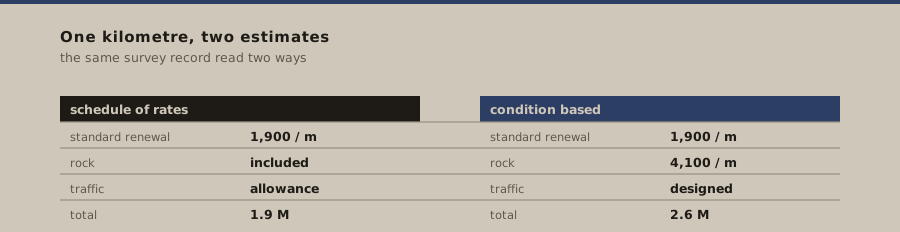
One kilometre of failing pipe, priced twice. A schedule of rates produced 1.9 million. A condition-based estimate using the actual defect pattern produced 2.6 million. Both were prepared by competent people from the same survey record.
Two costs for one pipe, and a ten-year gap between them
entered 2026-07-23period FY2026 · Q3 — closes 2026-09-30folio 304kept by The Scupper Ledger (a named ledger, not a person)
Why the two methods exist
A schedule of rates is fast, consistent and defensible across a programme, and it is the right tool for a first-pass estimate over fifty projects. A condition-based estimate is slower and needs the survey record read in detail, and it is the right tool for a project that is about to be funded. Using the first to decide a programme and the second to decide a contract is normal; using the first for both is how a programme overruns.
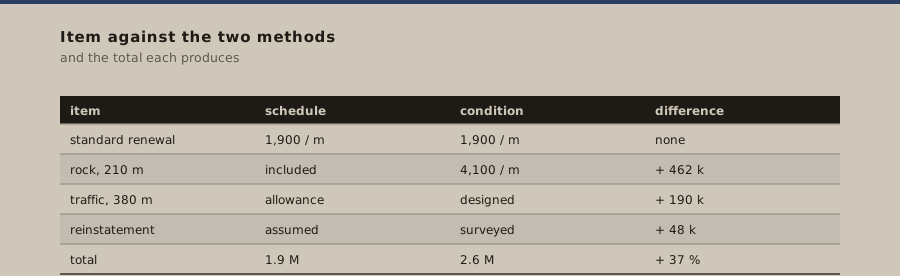
| Item | Schedule rate | Condition estimate | Difference |
|---|---|---|---|
| standard renewal | 1,900 / m | 1,900 / m | none |
| rock excavation, 210 m | included | 4,100 / m | + 462 k |
| traffic management, 380 m | allowance | detailed design | + 190 k |
| reinstatement type | assumed | as surveyed | + 48 k |
| total per kilometre | 1.9 M | 2.6 M | + 37 % |
Where the difference comes from
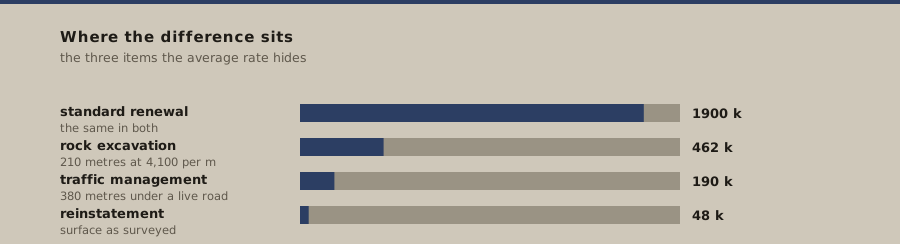
Not from the rate. The unit rate for a standard renewal was identical in both methods. The difference is entirely in the items that the average excludes: rock, traffic management, and the reinstatement surface. Those three are about a third of the total on this kilometre and they are invisible in a schedule rate.
The consequence for a programme is a systematic bias. If a schedule of rates understates the projects with unusual conditions and overstates the ones without, and if the unusual ones are also the ones that get deferred, then a programme built on schedule rates will look affordable for as long as it is deferred and will overrun the moment it is built.
A schedule of rates is not the same as a cost estimate, and a cost estimate is not the same as a bid. The first is a published price list, the second is a project-specific forecast, and the third is a contractor's offer. Confusing the first two produces a programme that cannot be delivered.
What this entry changes
It changes when the second estimate should be prepared. The usual practice is to prepare it at design, which is after the project has been funded and after the programme has been set. Preparing it at the point of ranking, before the programme is fixed, costs a small amount of engineering time and prevents a programme that cannot be built for the money it was given.
Documents posted to this account
- 01Minnesota Stormwater Manual | Minnesota Pollution Control Agencysupports the cost estimation and comparison method that the two estimates follow
- 02Minnesota Stormwater Manual (PDF)supports the same manual in its published document form, used for the unit rates
- 03Maryland Stormwater Design Manual - Department of the Environmentsupports the design manual whose reinstatement and excavation classes are applied
Each line points at one specific document, with its own title as the link text. No line is a home page and no line is a search result.
open Rule it off and stop Rule it off and stop once you know which method produced the number and what it averages away. The rate is not the difference.