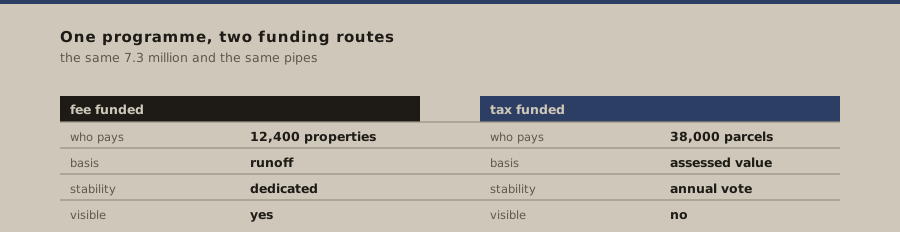
One city, one drainage programme, two ways to pay for it. The programme costs the same either way. What changes is which properties pay, how much each pays, and how exposed the money is to a bad budget year.
Fee-funded against tax-funded stormwater, on one programme
entered 2026-09-02period FY2026 · Q3 — closes 2026-09-30folio 301kept by The Scupper Ledger (a named ledger, not a person)
What actually differs
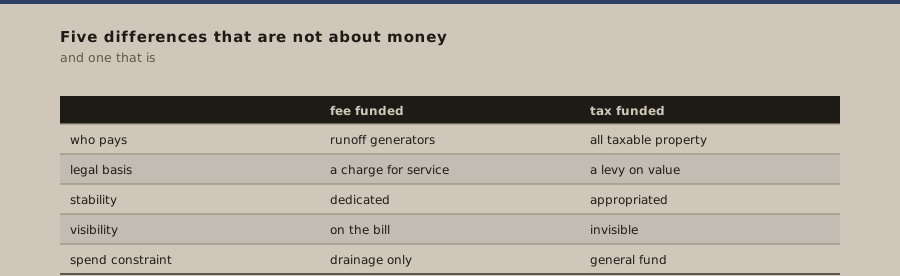
Four things, and only the first is about money. The paying population differs. The legal basis differs, which changes what the money may be spent on. The stability differs, because a fee is dedicated and a general-fund allocation is contested every year. And the visibility differs, because a fee appears as a line on a bill and a tax-funded programme does not appear at all.
| Fee funded | Tax funded | |
|---|---|---|
| who pays | properties that generate runoff | all taxable property |
| legal basis | a charge for a service | a levy on value |
| revenue stability | dedicated, predictable | appropriated annually |
| visibility to the payer | a line on a bill | invisible |
| spending constraint | the drainage system only | the general fund |
Why the dedicated revenue matters more than it looks
A fee-funded programme has a revenue stream that a council cannot reallocate without repealing the fee. That is the feature that lets a utility plan six years ahead, borrow against future revenue, and commit to a replacement reserve. A tax-funded programme can do none of those things with confidence, because the money is decided one year at a time.
The cost of that is political. A fee is visible and therefore unpopular, and the same programme funded invisibly from the general fund attracts no attention until the year the allocation is cut and the inlets are not cleaned. Both outcomes are real and both are consequences of the funding choice rather than of the engineering.
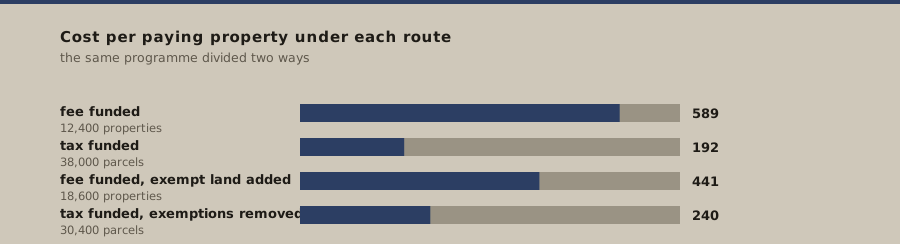
A fee is not the same as a tax, and the difference is not only legal. A fee can be set to recover the cost of the service; a tax can be set to raise revenue. That distinction is what allows a fee to be charged to a tax-exempt property, which is usually the largest landholder in the city and often the largest source of runoff.
What this entry changes
It changes the comparison a ratepayer is offered. A general-fund option presented as cheaper per household is comparing a large denominator with a small one, and the comparison omits that the small denominator is the one that actually causes the cost. Stated that way, the two options can be weighed on their merits instead of on their arithmetic.
Documents posted to this account
- 01Stormwater Fees Literature Review (UMD MOST Center)supports the literature review of how stormwater fees are structured and justified
- 02'Western Kentucky University Stormwater Utility Survey 2024' by Warren Campbellsupports the national survey data on which jurisdictions charge a fee and how many do not
- 032022 Florida Stormwater Association Stormwater Utility Reportsupports the state-level utility report the fee-funded comparison is drawn from
Each line points at one specific document, with its own title as the link text. No line is a home page and no line is a search result.
open Rule it off and stop Rule it off and stop once you know who pays under each option. The total is the same in both columns.