An impact fee is a one-off charge on new development, calculated from the cost of the capacity that development requires. It is not a rate and it does not fund renewal: it funds growth, and only growth.
How to write an impact fee study for stormwater
period FY2026 · Q3 — closes 2026-09-30folio 205recast the figures above move with the periodkept by The Scupper Ledger (a named ledger, not a person)
The six steps
The first two are legal and the rest are arithmetic. An impact fee needs an adopted plan, a demonstrated need created by new development, and a proportionate share calculation, and it needs a credit for any part of the cost that the developer is already paying through another mechanism.
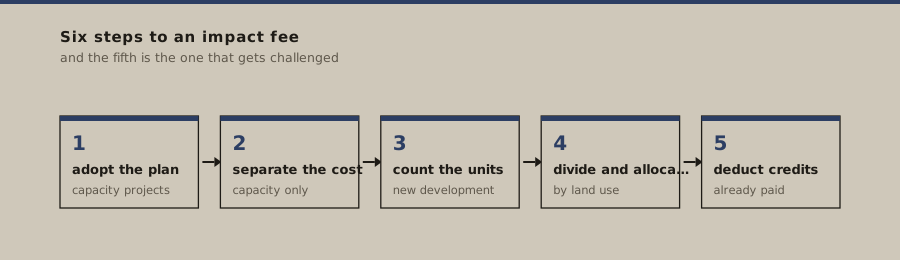
- Adopt a capital plan that identifies the capacity projects new development needs.
- Separate the eligible capacity cost from renewal, from operations and from correcting existing deficiencies.
- Estimate the new units the plan will serve, over a stated horizon.
- Divide the eligible cost by the units, and allocate between land uses on a defensible basis.
- Deduct credits for on-site control and for any other contribution the developer makes to the same capacity.
- Adopt the fee with a review date and a mechanism for spending the money on the projects it was collected for.
The credit is the hard part
A development rule that already requires on-site detention has made the developer pay for part of the capacity. Charging the full impact fee on top of that charges twice for the same capacity, and it is the most common way an impact fee is successfully challenged. The credit is not a concession; it is the correction of a double charge.
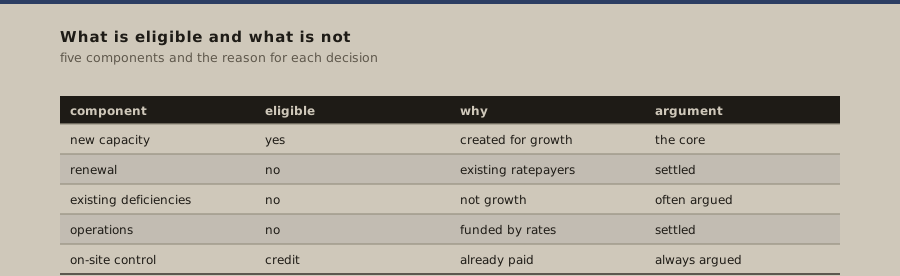
| Component | Eligible for the fee | Why | Argument |
|---|---|---|---|
| new capacity | yes | created for growth | the core of the fee |
| renewal of existing assets | no | existing ratepayers | settled |
| correction of existing deficiencies | no | not caused by growth | often argued |
| operations and maintenance | no | funded by rates | settled |
| on-site control already required | credit | already paid by the developer | always argued |

An impact fee is not the same as a connection charge, and neither is the same as a stormwater rate. A connection charge recovers the administrative cost of joining the system; an impact fee recovers capacity cost; a rate funds operations and renewal. Three different legal bases and three different spending rules.
Where this posting stops
This page covers the study. The programme the fee funds is owned by the capital plan account, the rate that funds the rest by the rate-setting posting, and the credit mechanism by the credit account.
Documents posted to this account
- 01Stormwater Local Improvement District (Clean Water Services)supports the local improvement district mechanism that a capacity charge is built on
- 02Establishing a Stormwater Volume Credit Trading Program (Arkansas)supports the volume credit trading structure an off-site credit can be modelled on
- 03Establishing a Stormwater Credit-Trading Program as an Off-Site Alternative for Compliancesupports the off-site compliance alternative that a credit programme implements
Each line points at one specific document, with its own title as the link text. No line is a home page and no line is a search result.
ruled off Rule it off and stop Rule it off and stop once the eligible cost and the credits are both separated out. Everything else is division.